AI Search Visibility: What It Is and How to Track It
August 9, 2026 · 8 min read
Buyers are increasingly asking AI engines for recommendations instead of searching Google. Here's what that means for your brand, how visibility gets measured, and what you can actually do about it.
What Is AI Search Visibility?
AI search visibility is how often — and how favorably — AI engines like ChatGPT, Claude, Gemini, Perplexity, Google AI, and Copilot mention your brand when someone asks a question your product could answer. It's the same underlying idea as traditional SEO visibility (how often you show up for relevant searches), applied to a channel where there is no results page, no ranked list of blue links, and often no way to see what the AI actually said unless you go ask it yourself.
That last part is what makes this hard. With Google, you can check your ranking any time. With an AI engine, the "answer" is generated fresh for each conversation, shaped by the model, the specific phrasing of the question, and — increasingly — real-time retrieval from the web. Two people asking a nearly identical question can get different brand recommendations. Visibility, in this context, is really a probability: how likely is it that your brand comes up, and in what light, across the range of questions your actual buyers are asking.
Why It's Becoming Critical for SaaS and B2B Brands
A meaningful and growing share of software buyers now start their research by asking an AI assistant for options — "what's a good CRM for a small agency," "alternatives to X that don't require a sales call," "cheapest tool for Y" — rather than typing a query into Google and clicking through ten tabs. For B2B and SaaS companies specifically, this matters because that first AI answer often functions as a shortlist. If your product isn't part of it, you don't lose a click — you lose the chance to even be considered.
This is also a channel most marketing teams have almost no visibility into. Google Search Console tells you exactly which queries you rank for. There is no equivalent dashboard, by default, for what ChatGPT or Perplexity is telling people about you. Traditional SEO tooling — rank trackers, backlink checkers, keyword volume — wasn't built to answer "does the AI even know we exist, and what does it say about us compared to our competitors."
How AI Search Visibility Gets Measured
Most tools built for this track a handful of the same core signals, even if the exact terminology differs:
Visibility score — a rough measure of how often your brand appears at all across a set of relevant prompts.
Share of voice — how often you're mentioned relative to named competitors for the same prompts, not just in isolation.
Prompt tracking — the specific, high-intent questions buyers actually ask ("best X for Y"), tracked over time rather than as a one-off snapshot.
Citation intelligence — which sources (review sites, comparison pages, directories, docs) the AI engine is actually pulling from and trusting when it forms its answer.
That last one — citation intelligence — is arguably the most actionable of the four. AI engines don't invent brand recommendations from nothing; they lean heavily on a smaller set of sources they treat as trustworthy for a given category (review sites, comparison content, structured directories, and increasingly, directly-cited product pages). Knowing which sources an engine is citing in your category tells you exactly where to focus content and outreach effort, instead of guessing.
How to Improve Your AI Search Visibility
There's no single trick here, and anyone promising a guaranteed AI ranking is overselling it — the same way "guaranteed #1 on Google" always was. What actually seems to move the needle is a combination of things AI engines can retrieve, parse, and trust:
Get cited by sources AI engines already trust. Independent directories, comparison pages, and review sites carry more weight than your own marketing copy — being listed, reviewed, and linked from a site like Gappsy is exactly the kind of third-party citation these engines lean on.
Write content that directly answers comparison and "best for" questions. Not vague feature lists — specific, structured answers to the actual questions buyers are typing into AI chat windows.
Keep pricing and positioning unambiguous. AI engines struggle to cite what they can't parse. Clear, published pricing (not "contact sales" for everything) and a clear one-line description of who the product is for both make it easier for a model to summarize you accurately.
Use structured data. FAQ schema, product schema, and clean semantic HTML help retrieval-augmented engines extract accurate facts rather than paraphrase-and-hope.
Finally, measure before you optimize. Without a baseline, you can't tell whether a change actually improved anything or whether you just got a different answer because the model felt like it that day.
Tools That Track AI Search Visibility
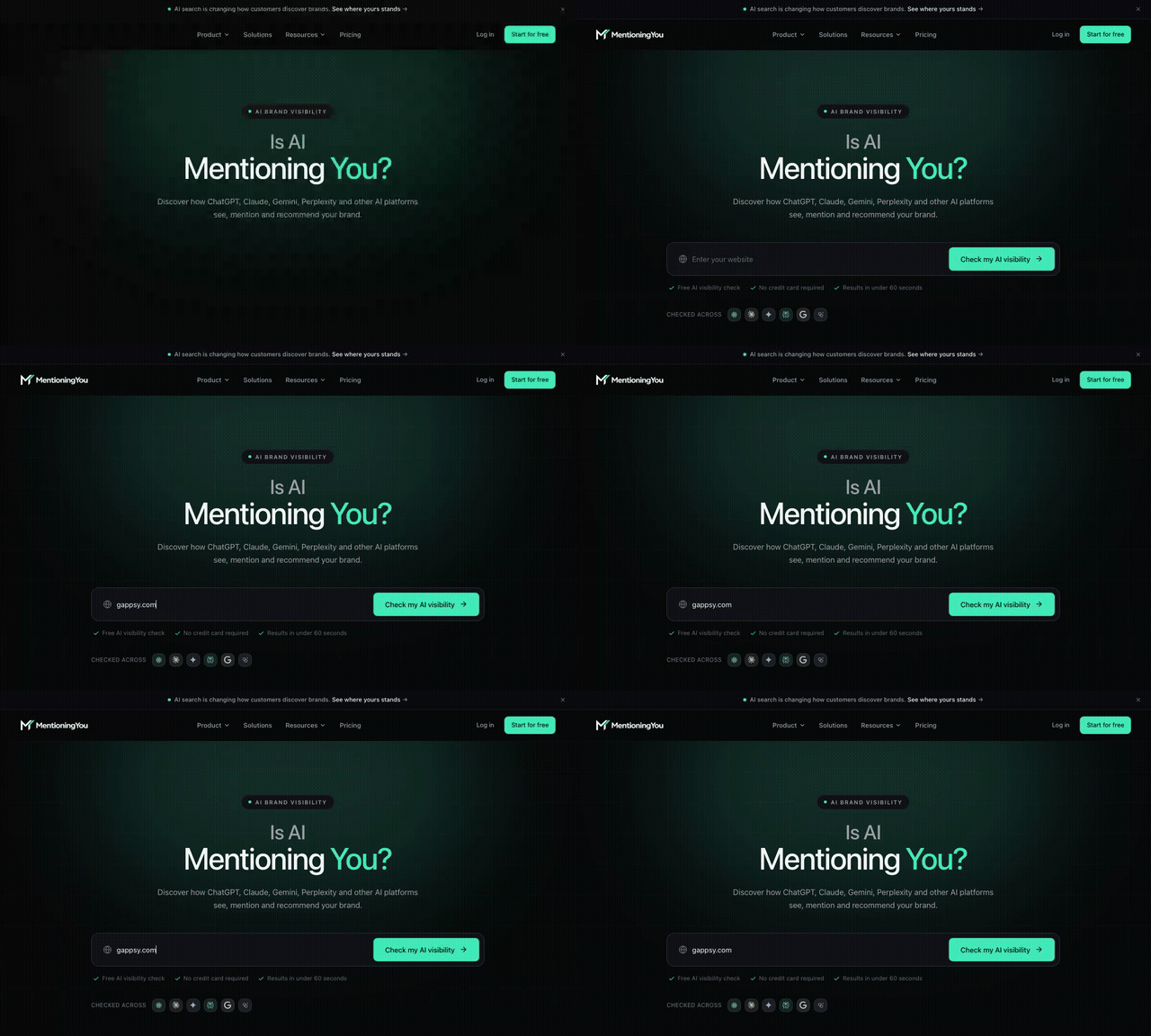
A handful of tools now specialize in exactly this — MentioningYou is one worth knowing about. It continuously monitors the high-intent prompts your buyers actually ask across ChatGPT, Claude, Gemini, Perplexity, Google AI, and Copilot, then reports your visibility score, your share of voice against named competitors, and — notably — the citation intelligence described above: which sources those engines are actually trusting and citing in your category.
The setup is about as low-friction as this category gets: point it at your domain and it auto-identifies your brand, category, and competitors, no manual keyword-list required. There's a free 60-second scan, no credit card required, if you just want a baseline reading before deciding whether ongoing tracking is worth it.
If your team already tracks traditional SEO rankings closely but has never checked what an AI engine says about you when a buyer asks for a recommendation, that free scan is a reasonable place to start — you may be surprised by what you find, in either direction.
Is AI mentioning you? Free 60-second scan across ChatGPT, Claude, Gemini, Perplexity, Google AI, and Copilot.
Visit mentioningyou.com → See full profile & pricing on Gappsy
Frequently Asked Questions
Is AI search visibility the same thing as SEO?
They're related but not the same. Traditional SEO optimizes for ranking in a search engine's results page. AI search visibility is about whether and how an AI engine mentions your brand in a generated answer — there's no results page, no fixed ranking, and the same underlying content (reviews, comparisons, structured data) that helps SEO also tends to help AI visibility, but the mechanics of "showing up" are different.
Can you guarantee a specific AI engine will recommend my product?
No — and treat any tool or agency that promises this with skepticism. AI answers are generated per-conversation and depend on the model, the exact phrasing of the question, and what the engine retrieves at that moment. What you can do is improve the odds: get cited by trusted sources, keep your positioning and pricing clear and parseable, and track your visibility over time so you know whether things are moving in the right direction.
How often should I check my AI search visibility?
Monthly is a reasonable cadence for most teams — frequent enough to catch real trends, infrequent enough that you're not reacting to normal day-to-day variance in how a model answers the same question. Tools built for continuous tracking (rather than a one-off manual check) make this easier to keep consistent.