9 Best Lovable Alternatives in 2026: AI App Builders Compared
November 12, 2026 · 14 min read
Nine Lovable alternatives compared on what they build, pricing as of November 2026, code access and who each one suits, from Bolt.new and Replit to Bubble.
The best Lovable alternatives in 2026
Lovable turns a chat prompt into a React web app with a Supabase backend. It is also credit-based, it hands you a codebase you are responsible for, and it builds web apps only. If one of those is the problem, another tool may fit better.
We compared nine alternatives on what they build, who they suit, what they cost and whether you get the code. Prices come from each vendor's official pricing page or documentation as of November 2026. Disclosure: Gappsy, pick #1, is our own product. We put it first for one specific need, building an app you can charge for and find customers for, and we list its limits like everyone else's.
Quick picks
• Build and sell a business app without code: Gappsy
• Closest like-for-like swap: Bolt.new
• AI agent plus a full coding environment: Replit
• React and Next.js on Vercel: v0
• Complex logic without code: Bubble
• Native mobile apps with exportable code: FlutterFlow
• Portals and internal tools on your data: Softr
• Spreadsheet-to-app for teams: Glide
• No-code apps for the App Store and Google Play: Adalo
Why people look for a Lovable alternative
Lovable does a lot well. Our Lovable review credits it with real, editable full-stack code, native Supabase integration, a fast prompt-to-deploy loop and unlimited team members on every plan. People still switch, usually for one of these reasons.
Credits are hard to predict. Each message costs a variable number of credits; Lovable's own examples range from 0.50 credits to make a button gray to 1.70 for a landing page with generated images. Pro starts at $25 a month for 100 credits ($21 billed yearly) and the Free plan gives 5 credits a day, up to 30 a month. Hosting on Lovable Cloud and AI features inside your app draw from the same balance, so a busy app costs more than the plan price suggests.
You own the code, and the code review. Git sync to GitHub, GitLab or Bitbucket comes on every plan, which developers love. For non-developers it means that when something breaks, the fix is in code they did not write, and complex or security-sensitive apps need review before launch.
Backend and deployment follow its stack. The default is a web app on Supabase or Lovable Cloud. If you need a native store app, a backend in another language, or payments and bookings that already work, other tools start closer to the finish line.
It is young. Best practices and workarounds are still emerging, in a field where Bolt.new, v0 and Replit compete for the same users.
1. Gappsy – Best for building an app you can sell and find customers for
Gappsy is our own product, so weigh this pick accordingly — we've listed its limits too.
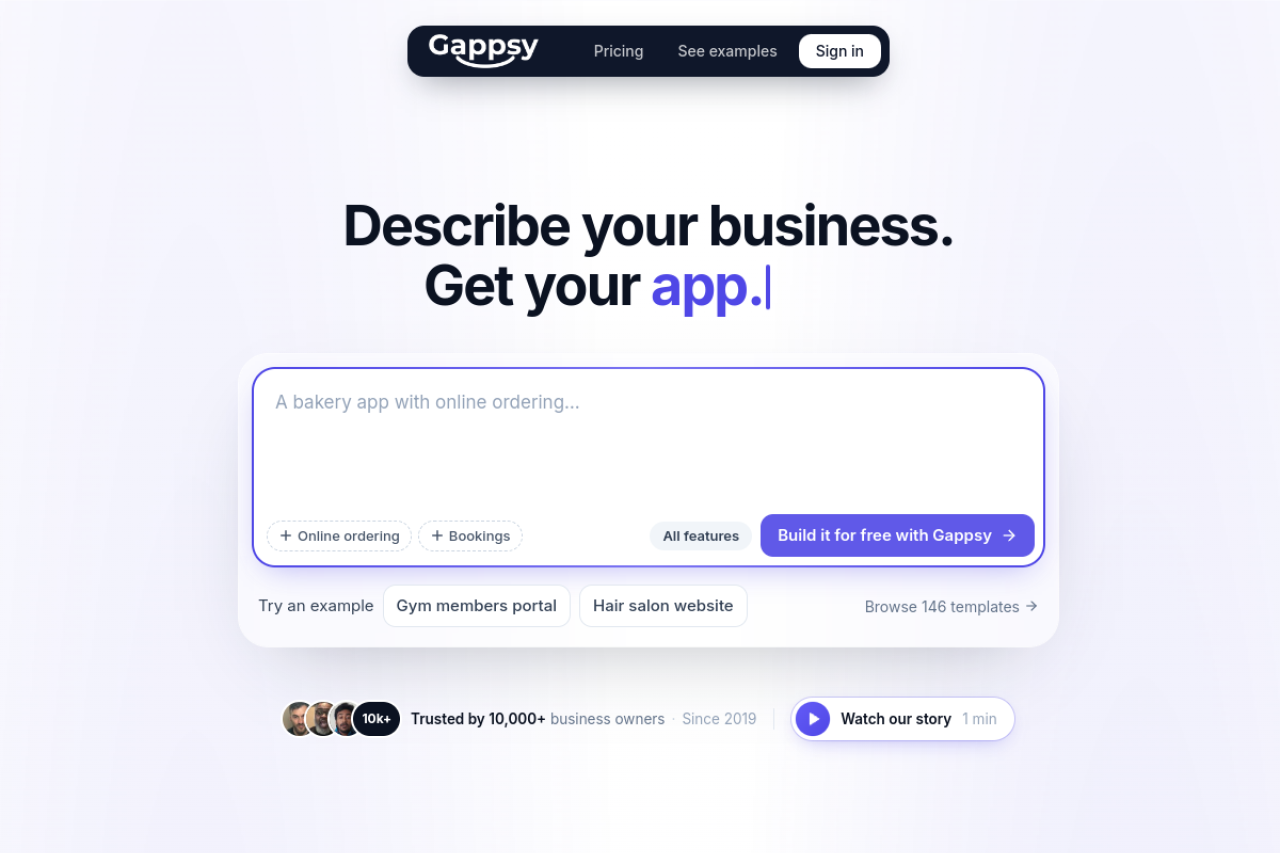
Gappsy is an AI app builder for people who want a running business product rather than a codebase. Describe your business or idea in a sentence or two, in any language, and it builds a live installable app, a website and the tools you asked for. You change things by typing ("add online booking") or by tapping the app to edit texts, photos and prices, which is unlimited on every plan.
The difference from Lovable is how apps are made. Instead of generating new code, Gappsy assembles apps from 56 built-in feature blocks: ordering, bookings, memberships, gift cards, events and tickets, forms, courses, a CRM-style workspace and more. Customers pay into your own Stripe account, one-time or by subscription, and hosting, database, customer accounts, push notifications and an Apple and Google Wallet loyalty card are included. It can also build ready-made rebrandable software, such as a CRM, that you sell to others as SaaS. And because Gappsy sits on a software directory with 7,000+ profiles across 75 categories, you can list what you build in front of people already comparing software to buy.
Pricing: Free is $0 for one app on yourname.gappsy.co with 300 visitors and 10 AI changes a month, a 5% payment fee and a "Made with Gappsy" label. Pro is $19 a month billed yearly or $29 monthly, with your own domain, a 1% fee, 3,000 visitors and 50 AI changes. Business is $55 a month yearly or $79 monthly, with 5 apps, 150,000 visitors and no Gappsy fee. Stripe's fees apply on top. Pro also lets you publish to the App Store and Google Play yourself, as packaged web apps under your own developer accounts. See Gappsy vs Lovable or try the app builder.
Pros
• Payments, bookings, memberships and tickets work from day one, paid to your own Stripe
• Free plan goes live with every feature, including payments
• Fixed monthly AI allowance plus unlimited tap-editing, not per-message credits
• List what you build on Gappsy's software directory
Cons
• No code export: apps are built from feature blocks, not generated code
• Less freeform than Lovable or Bolt.new, and less custom logic than Bubble
• Newer product than most on this list; Free plan limits are tight
• Store publishing needs Pro plus Apple ($99/year) and Google ($25 once) developer accounts
Best for: founders, freelancers and local businesses that want a live app taking payments and bookings, or a SaaS to rebrand and sell, without maintaining code.

Describe your business or idea and get a live app, website and tools with payments, bookings and memberships.
2. Bolt.new – Best like-for-like replacement for Lovable
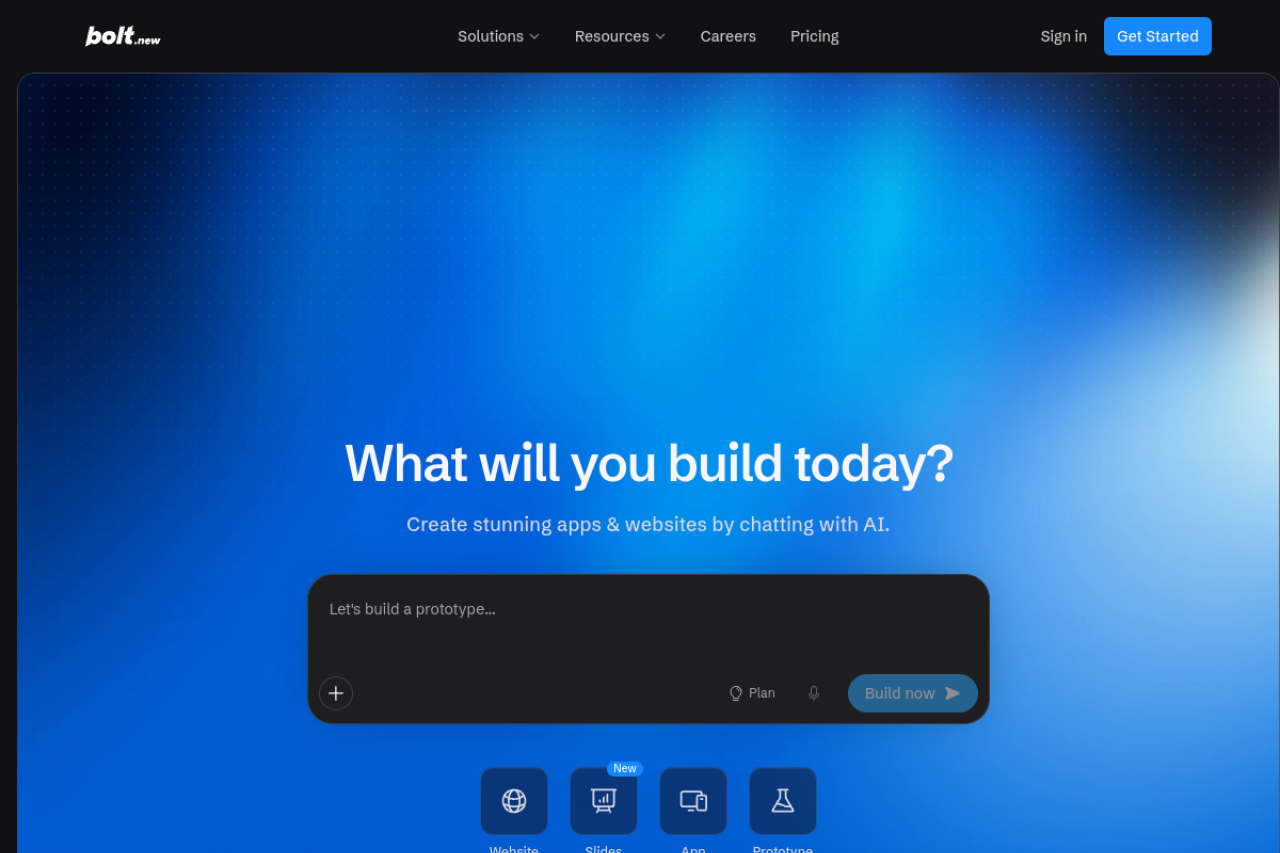
Bolt.new from StackBlitz is the closest thing to Lovable. A prompt generates and runs a full-stack web app in the browser on StackBlitz's WebContainers, you refine the real code by chat, and it integrates with Supabase, GitHub, Netlify, Stripe and Cloudflare. If you like Lovable's workflow but not its billing, this is the shortest move.
Bolt meters tokens instead of credits, spending them whenever it reads your prompts and project files or writes code, so big projects use more. As of November 2026, Free includes 1M tokens a month (300K a day) with Bolt branding and hosting. Pro is $25 a month billed monthly (yearly saves up to 28%), starts at 10M tokens and adds a custom domain. Teams is $30 per member. Unused paid tokens roll over for up to two months.
Compare Lovable vs Bolt.new and Bolt.new vs Gappsy.
Pros
• Same prompt-to-code workflow as Lovable, little to relearn
• Runs fully in the browser, no setup
• Paid tokens roll over for two months
Cons
• Token costs are hard to predict on larger projects
• Very large projects can hit browser performance limits
• Serious ongoing work usually needs a higher tier
Best for: Lovable users who want the same experience with a different pricing model.
Bolt.new is StackBlitz's AI app builder that generates and runs full-stack web apps in the browser from a text prompt, using WebContainers.
3. Replit – Best for an AI agent plus a full coding environment
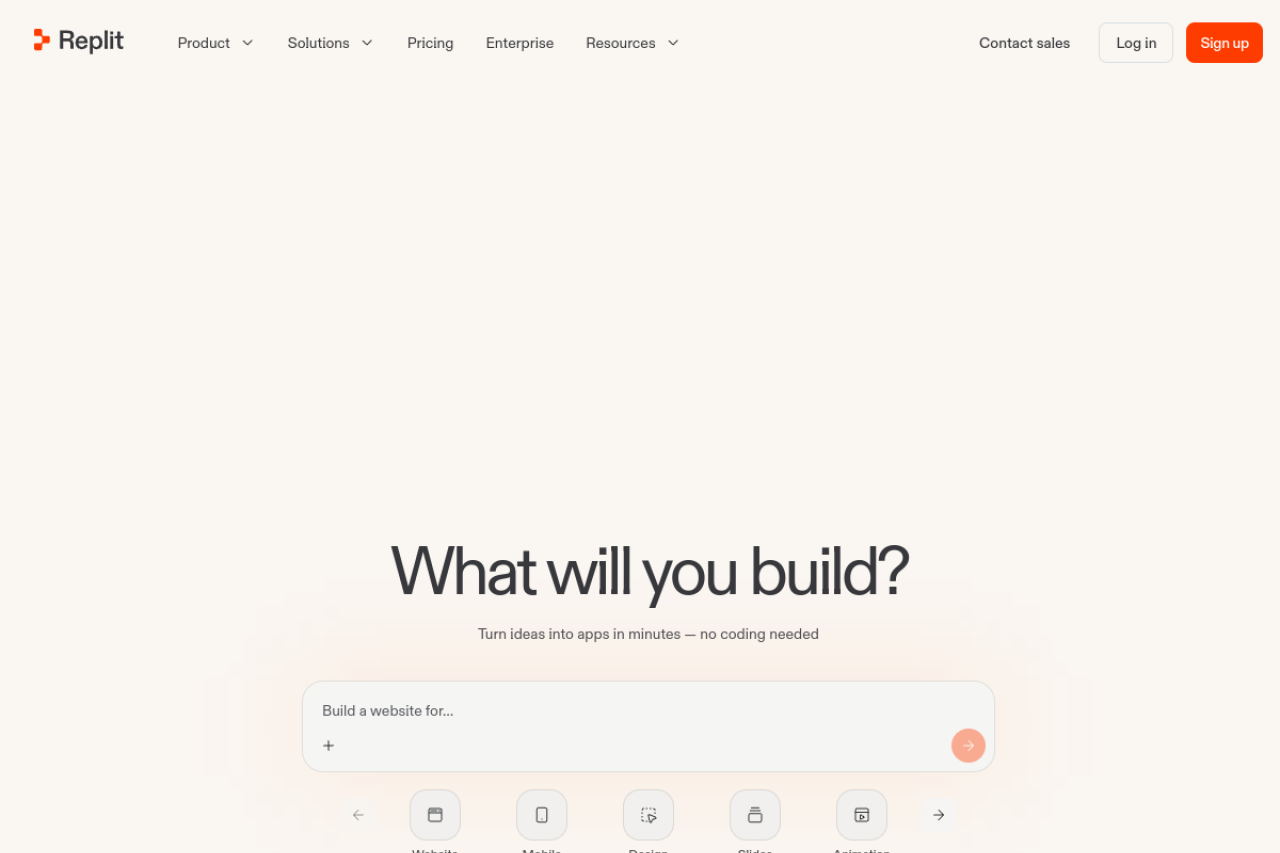
Replit is a browser-based development platform whose AI Agent builds and deploys apps from plain-language prompts. Unlike Lovable it is a complete coding environment: every file is open, many languages work, databases and deployment are built in, and you can collaborate in real time. That suits projects needing a real backend or a developer taking over later.
As of November 2026, Replit's pricing page lists Core at $20 a month ($18 billed annually) with $20 of usage toward more powerful models, and Pro at $100 ($90 annually) with $100 of usage, up to 15 collaborators and 28-day database rollback. Enterprise is custom. As with Lovable, heavy agent use can cost more than the plan price.
Compare Lovable vs Replit and Gappsy vs Replit.
Pros
• AI Agent plus a full IDE, from prompt to hand-written code
• Built-in databases and deployment
• Real-time collaboration
Cons
• Usage costs can exceed the subscription price
• AI-generated code and database changes need review
• More technical than Lovable for people who never want to see code
Best for: technical founders and developers who want AI help and full control of the code, in any language.
Replit is a browser-based coding and AI app-building platform that lets developers write, run, deploy, and collaborate on software from…
4. v0 – Best for React and Next.js developers on Vercel
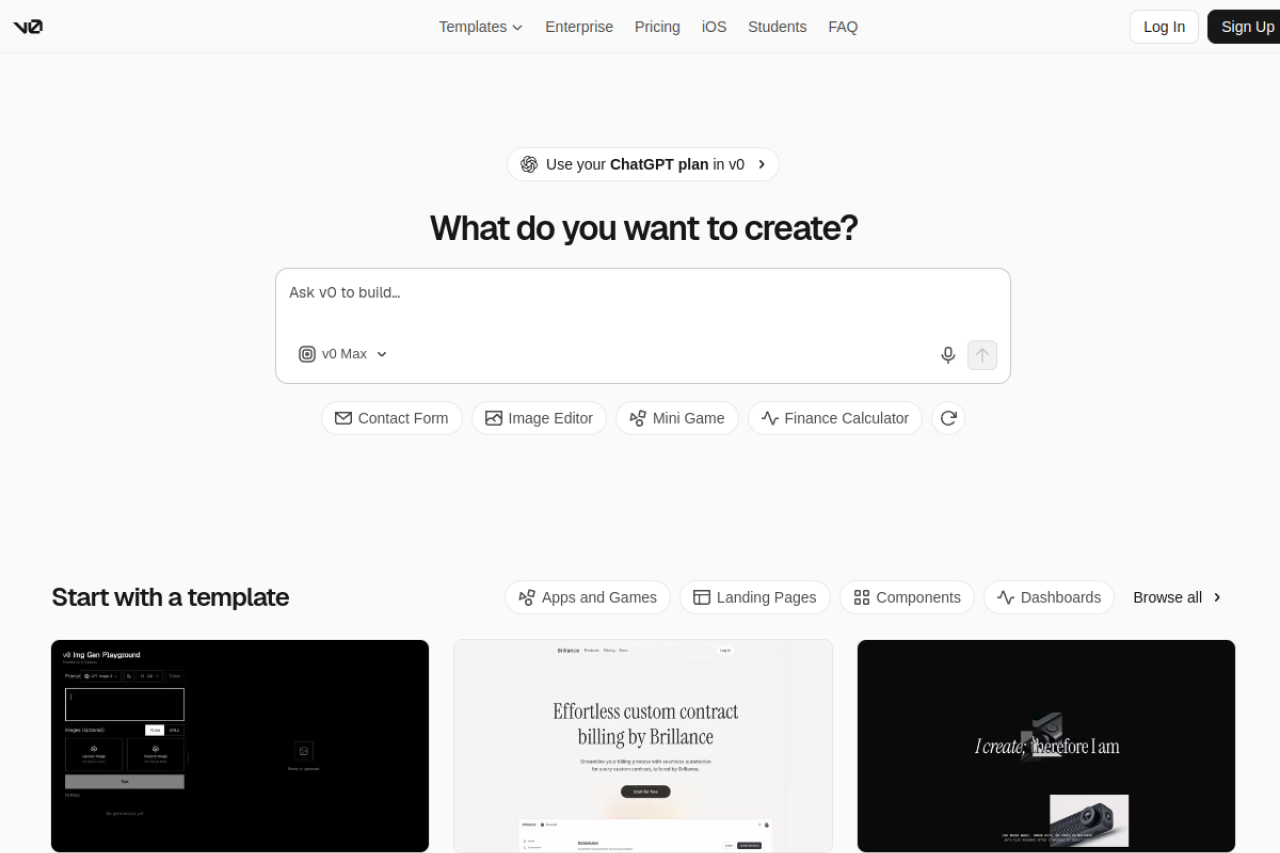
v0 is Vercel's AI builder. It generates React and Next.js interfaces and full-stack code on shadcn/ui components and deploys to Vercel in one click, with a visual Design Mode and GitHub sync on every plan. Compared with Lovable it is more developer-oriented and tied to the Vercel ecosystem, and its strength is well-structured UI code.
As of November 2026: Free has a 7-message daily limit (plus $5 in one-time credits for new users), Plus is $30 per user a month with $30 of monthly credits and $2 of free daily credits, Business is $100 per user a month with training opt-out by default, and Enterprise is custom. Usage is billed per token at model-specific rates.
Compare Lovable vs v0 and Bolt.new vs v0.
Pros
• Fast path from a description to styled React code
• Deep Next.js, shadcn/ui and Vercel integration
• Design Mode and GitHub sync on Free
Cons
• Token pricing adds up with heavy use
• Tightly coupled to Vercel and Next.js
• Free plan capped at 7 messages a day
Best for: developers and designers building React or Next.js front ends who deploy on Vercel.
v0 is Vercel's AI-powered tool that generates working React and Next.js user interfaces and full-stack app code from natural-language…
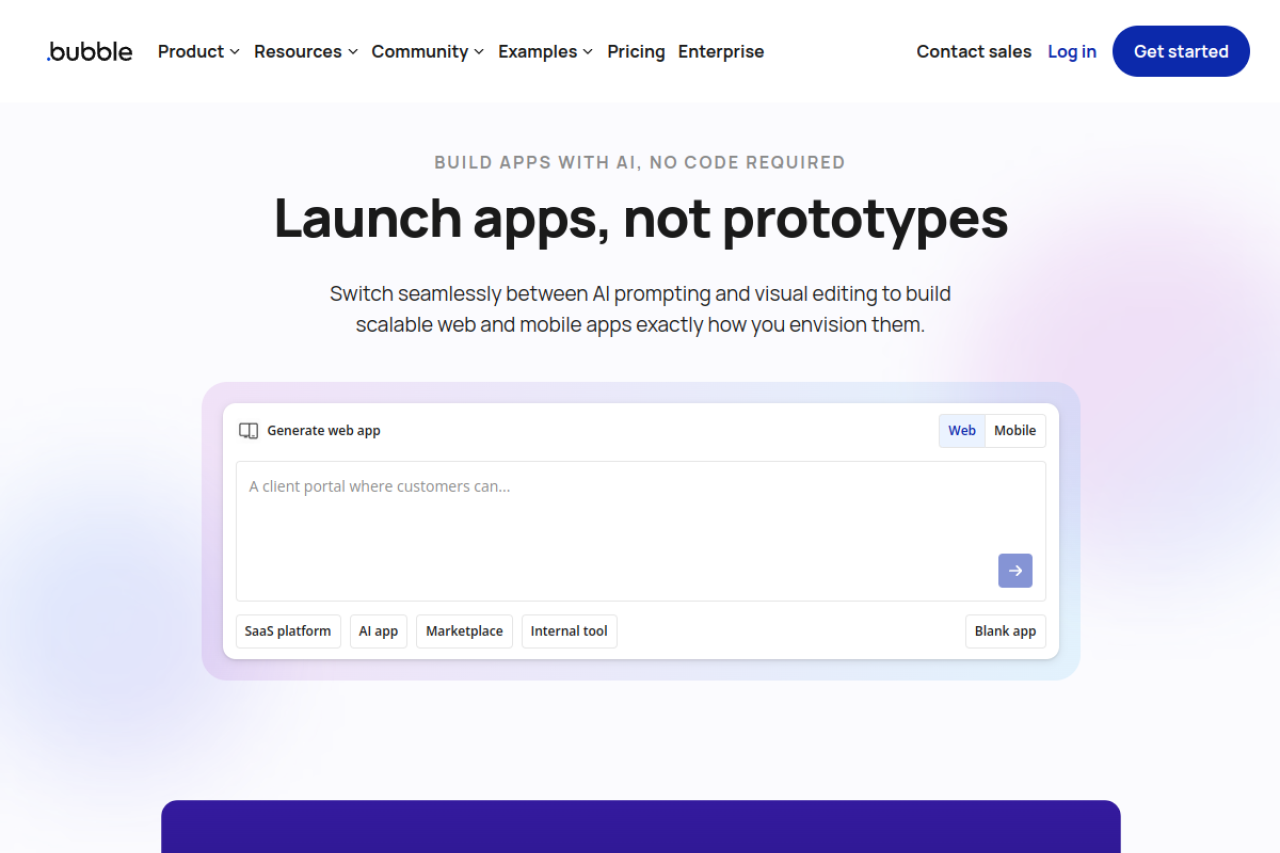
5. Bubble – Best for complex custom logic without code
Bubble is the most established visual no-code platform for full-stack web and mobile apps. You design the interface, database and workflows in a visual editor and extend it with a large plugin ecosystem. There is no code to export: apps run on Bubble's own runtime. Where Lovable writes code from a prompt, Bubble asks you to learn its editor, which takes longer but gives non-developers precise control over data and logic.
Per Bubble's manual as of November 2026, web-only plans are Starter at $32 a month billed annually ($39 monthly), Growth at $119 ($134) and Team at $349 ($399), with a free plan for building. Mobile plans cost more, and server usage is metered in workload units.
Compare Bubble vs Gappsy and Adalo vs Bubble.
Pros
• Database, logic and UI in one visual tool
• Large plugin ecosystem
• Extensible with APIs and custom code
Cons
• Steeper learning curve than prompt-based builders
• Workload-unit pricing can be hard to predict
• Leaving means rebuilding, since apps run on Bubble's runtime
Best for: non-developers building a complex product, such as a marketplace, who will learn a visual editor in exchange for control.
Bubble is a no-code platform for building full-stack web and mobile applications visually, without writing traditional code.
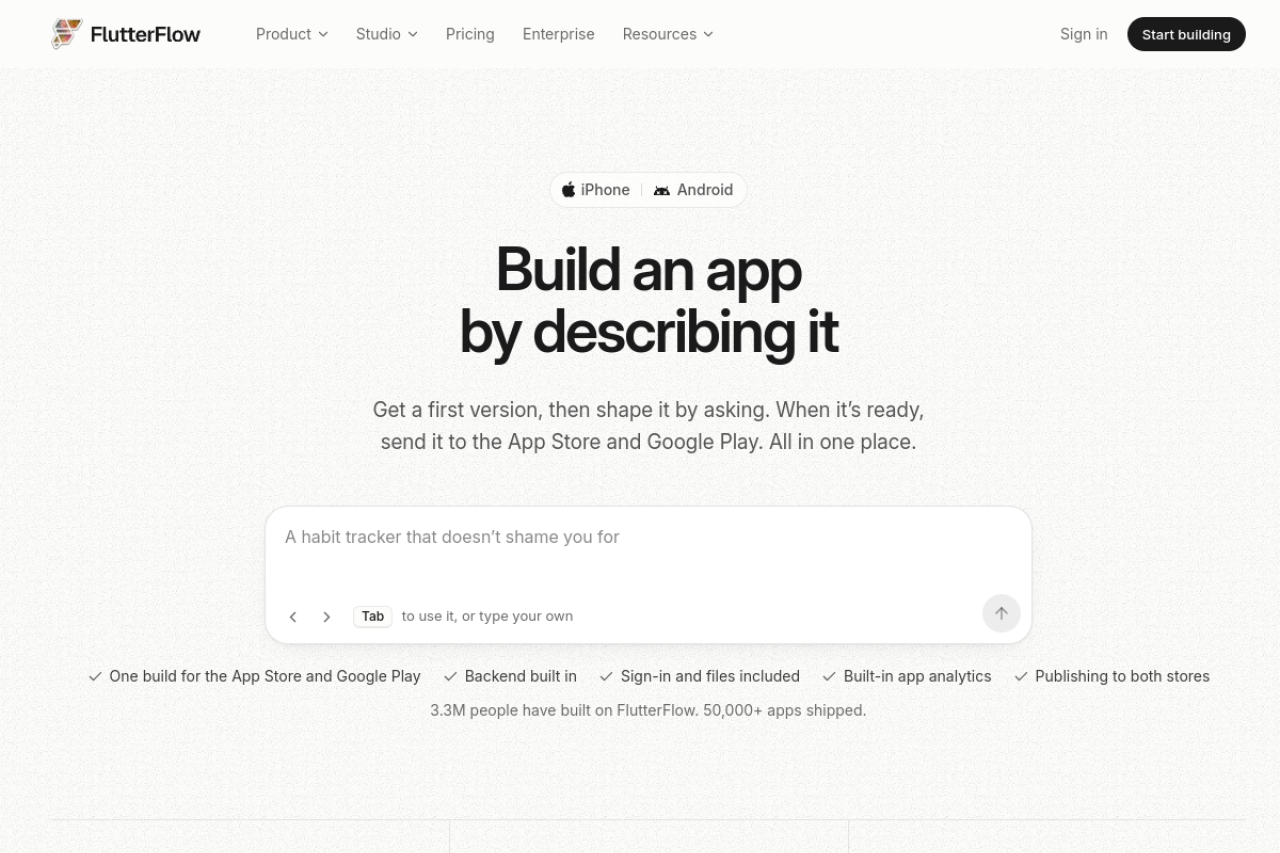
6. FlutterFlow – Best for native mobile apps with exportable code
FlutterFlow is a visual builder that generates real Flutter code for iOS, Android, web and desktop, with Firebase, Supabase and REST API integrations. It covers Lovable's biggest gap, native mobile, and lets you export the code. It is more hands-on: you lay out screens visually, and complex logic is easier with some Dart.
As of November 2026: Free includes 2 projects and a free AI allowance, Basic is $39 a month ($29 billed yearly), Pro is $80 ($60 yearly) with 2.5 times Basic's AI usage and 2 editors, and Max is $150 ($113 yearly) with up to 5 editors. Enterprise is custom.
Pros
• Exportable Flutter code, not a proprietary runtime
• One project ships to iOS, Android, web and desktop
• Firebase and Supabase integration
Cons
• Seat pricing adds up for teams
• AI usage limited on lower tiers
• More manual work than prompt-first builders
Best for: builders who need real App Store and Google Play apps and want to own the code.
FlutterFlow is a visual, drag-and-drop app builder that generates real Flutter code for iOS, Android, web, and desktop, with Firebase,…
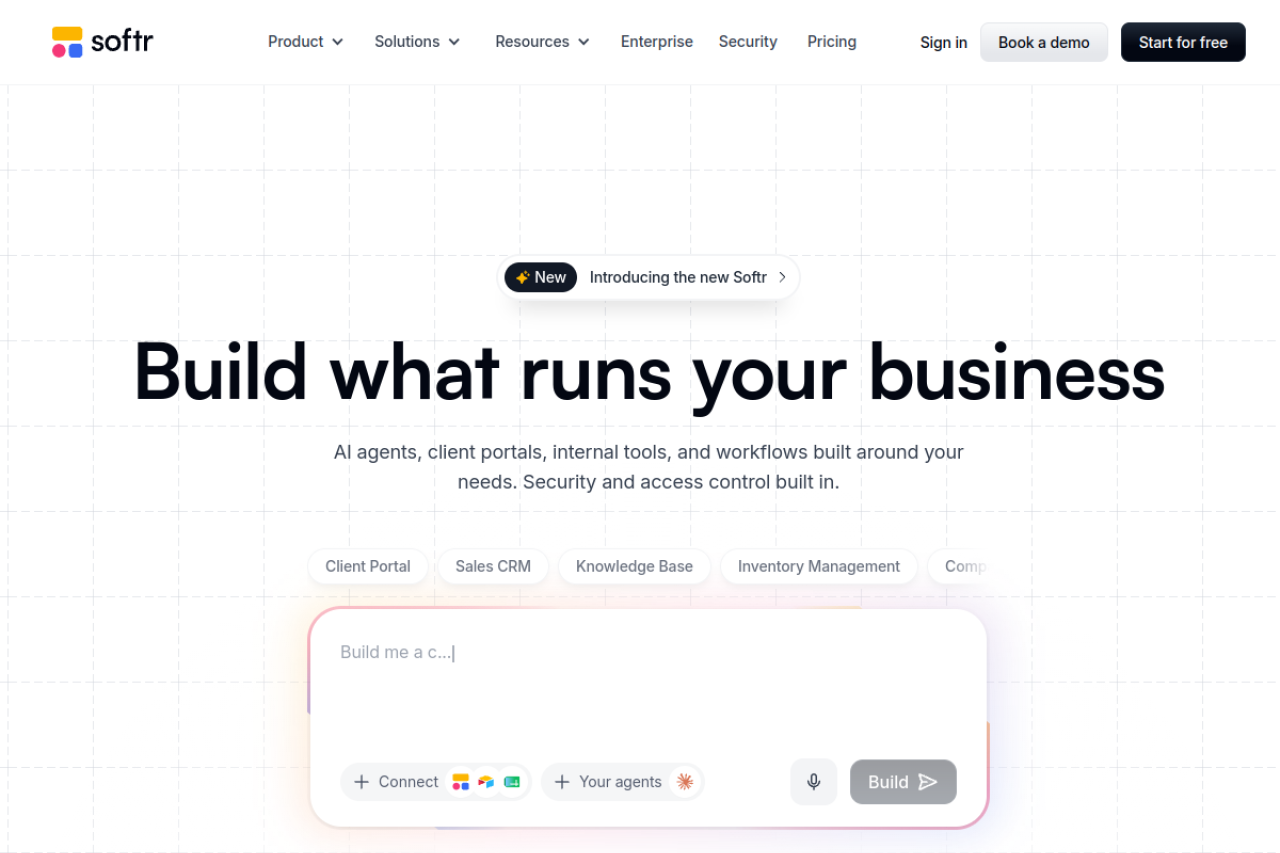
7. Softr – Best for client portals and internal tools on your data
Softr builds business apps, client portals and internal tools on data in Airtable, Google Sheets, HubSpot, SQL databases or its own Softr Databases, with an AI co-builder for the first draft and built-in logins, permissions and payments. It replaces Lovable when you need a portal around data you already have rather than a custom product.
As of November 2026, Softr lists a Free plan with 5 AI credits a month, Basic from $19 a month with a custom domain, and Pro from $99, which removes Softr branding and adds custom code and API connectors. Yearly billing takes two months off, and plans cap app users, records and workflow actions. Compare Bubble vs Softr and Gappsy vs Softr.
Pros
• Fast launch from existing spreadsheets and databases
• Many data sources, including Airtable, HubSpot and SQL
• Usable free plan
Cons
• Costs scale with app users and AI credits
• Complex logic needs custom code
• Performance depends on the data source, especially large Airtable bases
Best for: operations teams and agencies building client portals and internal tools.
Softr is a no-code and AI-native platform for building business apps, client portals, and internal tools directly from data in Airtable,…
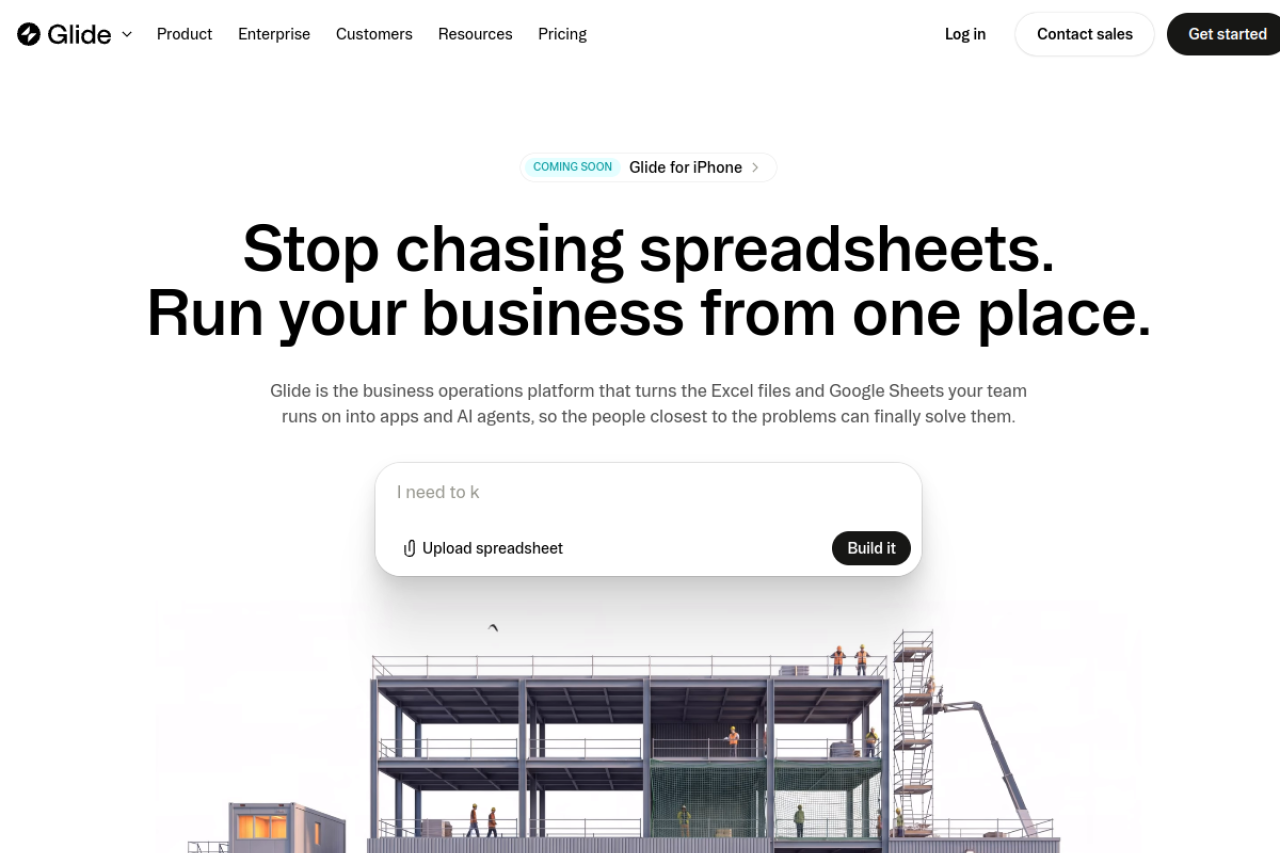
8. Glide – Best for turning spreadsheets into team apps
Glide turns spreadsheets and other data into mobile-friendly business apps, with AI that generates layouts, workflows and agents from plain-language descriptions. Compared with Lovable it trades flexibility for speed: there is no codebase and apps live on Glide, but a team can turn a sheet into a working tool quickly. Glide states that user data is not used to train its AI models.
As of November 2026, Free lets you build but not publish apps. Basic is $25 a month with 2 published apps, Plus is $50 with 5 published and public apps, and Pro is $125, starting at 5 team members, with unlimited published apps. Enterprise is custom.
Pros
• Strong on-ramp from existing spreadsheets
• AI first drafts for non-technical users
• Mobile-first output
Cons
• Free plan cannot publish apps
• Costs scale with credits and team members
• No code export; apps are hosted inside Glide
Best for: teams turning spreadsheets into internal apps quickly.
Glide is a no-code platform that turns spreadsheets and other data sources into custom web and mobile business apps, with AI tools to…
9. Adalo – Best for no-code native apps in the app stores
Adalo is a drag-and-drop builder for native iOS, Android and web apps, with a hosted database and an AI assistant called Ada. Unlike Lovable, publishing to the App Store and Google Play is the core use case, and you do it without code. It is simpler than FlutterFlow but gives you less control.
As of November 2026, Free lets you build and test unlimited apps with 500 records per app and 5 Ada prompts a month. Builder is $65 a month, or $52 billed yearly, with 2 published apps, store and web publishing, custom domains, Stripe and push. Business is $200 a month ($160 yearly) with 5 published apps, external databases and access to view all of Ada's code. See Adalo vs Bubble.
Pros
• True no-code path to native store apps
• Built-in database and AI assistant
• Free plan for prototyping
Cons
• Publishing needs a paid plan
• Record limits on lower tiers
• Costs rise with published apps and editors
Best for: non-developers who want a native app in the stores without writing or managing code.
Adalo is a no-code platform for designing and publishing native iOS, Android, and web apps using a drag-and-drop visual builder, a…
Lovable alternatives compared
How the nine picks line up, with Lovable as the reference point.
| Tool | Best for | Starting price | Builds | Code access |
|---|---|---|---|---|
| Gappsy | Building and selling a business app | Free; Pro $19/mo yearly ($29 monthly) | Installable app + website; store packages on Pro | No export (block-based) |
| Bolt.new | Like-for-like Lovable swap | Free; Pro $25/mo | Full-stack web apps | Full code, GitHub |
| Replit | AI agent + coding environment | Core $20/mo ($18 yearly) | Web apps and backends, many languages | Full code in an IDE |
| v0 | React/Next.js on Vercel | Free; Plus $30/user/mo | React and Next.js apps | Full code, GitHub sync |
| Bubble | Complex logic without code | Free; Starter $32/mo yearly ($39 monthly) | Web and mobile apps | No (Bubble runtime) |
| FlutterFlow | Native mobile with code | Free; Basic $29/mo yearly ($39 monthly) | iOS, Android, web, desktop | Flutter code export |
| Softr | Portals and internal tools | Free; Basic from $19/mo | Web apps on your data | No (custom code on Pro) |
| Glide | Spreadsheet-to-app | Free; Basic $25/mo | Mobile-friendly business apps | No |
| Adalo | No-code native store apps | Free; Builder $52/mo yearly ($65 monthly) | iOS, Android, web | View code on Business |
| Lovable (reference) | Prompt-to-code web apps | Free; Pro $25/mo ($21 yearly) | Full-stack web apps | Full code, Git sync |
Prices from each vendor's official pricing page or documentation as of November 2026, before taxes and usage overages. Credit-, token- and workload-based tools can cost more than the plan price.
How to choose a Lovable alternative
Start from what you want at the end, not from the tool.
• Code you can hand to a developer: Bolt.new, v0 or Replit. If you outgrow chat-based builders, AI code editors such as Cursor and Windsurf are the usual next step (see Lovable vs Cursor and Lovable vs Windsurf).
• A business that takes payments, with no code to maintain: Gappsy.
• A complex custom product without code: Bubble.
• A native mobile app: FlutterFlow if you want the code, Adalo if you don't.
• A tool around data you already have: Softr or Glide.
Before paying, check three things: how usage is metered (credits, tokens, workload units, AI changes or app users all grow differently), what you can take with you if you leave (code, data or neither), and what going live really costs once you add a custom domain, remove branding and publish to the stores. Nearly every tool here has a free plan, so build the same small app in your top two and keep the one that gets you closer to something you would show a customer.
Frequently Asked Questions
What is the best alternative to Lovable?
It depends on the job. Bolt.new is the closest replacement, with the same prompt-to-code workflow but token pricing. Replit suits developers who want a full coding environment, v0 suits React teams on Vercel, and Bubble suits non-developers building complex apps. Gappsy (our own product) fits if you want payments, bookings and memberships built in and no code to maintain.
Is there a free Lovable alternative?
Most have free plans with limits. As of November 2026, Bolt.new includes 1M tokens a month, v0 allows 7 messages a day, and Gappsy lets you go live with payments on a gappsy.co address (300 visitors, 10 AI changes a month, 5% fee). Bubble, FlutterFlow, Softr, Glide and Adalo also have free plans, though Glide's cannot publish apps.
What is the difference between Lovable and Bolt.new?
Both turn prompts into full-stack web apps with real code. Lovable bills in credits per message and centers on Supabase and Lovable Cloud; Bolt.new bills in tokens and runs projects in the browser on StackBlitz WebContainers. Both start paid plans at $25 a month billed monthly as of November 2026.
Is Lovable better than Bubble?
They suit different people. Lovable is faster to start and gives you code you own and must maintain. Bubble takes longer to learn but gives non-developers fine control over data and logic, and keeps apps on its own runtime, which makes leaving harder.
Which Lovable alternative builds native mobile apps?
FlutterFlow builds native iOS and Android apps with exportable Flutter code. Adalo builds native apps without code and publishes to the stores on paid plans. Gappsy makes an installable app and, on Pro, packaged store apps you publish under your own developer accounts. Lovable builds web apps.
Can I export my code from Lovable alternatives?
Bolt.new, v0, Replit and FlutterFlow give you code. Bubble, Glide and Softr do not, since apps run on their platforms. Adalo lets you view its AI assistant's code on the Business plan. Gappsy has no code export because apps are assembled from built-in feature blocks.
How does Lovable pricing work?
Lovable charges in credits. As of November 2026, Free gives 5 credits a day up to 30 a month, Pro starts at $25 a month for 100 credits ($21 billed yearly) and Business at $50 ($42 yearly). Messages cost a variable number of credits, and Cloud hosting and in-app AI draw from the same balance.
Can I sell an app I build with an AI app builder?
Yes. With code generators such as Lovable or Bolt.new you connect Stripe and build billing yourself. Gappsy includes one-time payments and subscriptions to your own Stripe account, can produce rebrandable software others pay you for, and lets you list it on Gappsy's software directory.