Deno Deploy vs Discord vs DIY: Which Is Right for You in 2026?
There's no real competitive overlap between these three — Deno Deploy is developer infrastructure, Discord is a general-purpose communication platform, and…
Freemium · From Free
Best for: Developers deploying JavaScript or TypeScript applications who want serverless hosting on V8 isolates without managing servers.
Freemium · From Free (Nitro from $2.99/month)
Best for: Any community, gaming group, team, or friend group that needs free, persistent voice, video, and text chat spaces.
Freemium · From Free
Best for: Parents and kids ages 6-16 who want AI-guided coding and creative projects with human-reviewed feedback in a moderated community.
At a Glance
| Deno Deploy | Discord | DIY | |
|---|---|---|---|
| Primary category | Productivity | Productivity | Productivity |
| Rating | Not documented | Not documented | Not documented |
| Pricing model | Freemium | Freemium | Freemium |
| Starting price | Free | Free (Nitro from $2.99/month) | Free |
| Free plan | Yes | Yes | Yes |
| Free trial | Not documented | Not documented | Yes |
| Platforms | Not documented | Web, iOS, Android, Mac, Windows | Web |
| Team collaboration | Not documented | Not documented | Not documented |
| AI features | Not documented | Not documented | Yes |
| Public API | Yes | Yes | Not documented |
Standout Differences
No real competitive overlap among the three
Serverless application hosting, general community chat, and a children's learning platform address entirely different needs and buyers — there's no scenario where someone is choosing between these three as substitutes for each other.
Deno Deploy, Discord, DIY
Discord's monetization is unusually consumer-friendly
Discord's core product — creating and joining servers, text/voice/video chat — is entirely free with no functional paywall. Discord Nitro is an optional personal add-on (from $2.99/month) that adds perks like custom emoji and HD streaming, rather than gating real functionality the way most freemium products do.
Discord
Deno Deploy is pure infrastructure, not a community or content product
Deno Deploy runs JavaScript/TypeScript code on V8 isolates as a serverless hosting platform from Deno Land Inc., with a free tier for getting started. It has nothing to do with chat, community, or education — it's the deployment layer a developer might use to ship an app that a Discord community or a kids' platform runs on.
Deno Deploy
DIY.org is the only one purpose-built for children
DIY.org is a subscription platform specifically for kids ages 6-16, combining AI-guided projects, human-reviewed feedback, and a moderated online community — a materially different safety and design bar than Discord's general-purpose, open communities.
DIY
Feature-by-Feature
Audience & Purpose
| Feature | Deno Deploy | Discord | DIY |
|---|---|---|---|
| Built for developer infrastructure/hosting | Available | Unavailable | Unavailable |
| Built for general real-time communication | Unavailable | Available | Limited |
| Built specifically for children's education | Unavailable | Unavailable | Available |
Pricing Model
| Feature | Deno Deploy | Discord | DIY |
|---|---|---|---|
| Free tier or free core product | Available | Available | Available |
| Optional paid add-on that doesn't gate core functionality | Not documented | Available | Not documented |
Pricing Compared
Starting price reflects the lowest paid tier, not the full cost for every team size or usage level.
Deno Deploy
Discord
DIY
Pros & Cons
Deno Deploy
Pros
- Generous free tier covering 1 million requests per month
- Very fast cold starts thanks to the V8 isolate architecture
- Works with most popular JS/TS frameworks, not just Deno-native projects
- Offers a self-hosted option for enterprises that can't use a third-party cloud
- SOC 2 Type II and ISO 27001 certified
Cons
- Higher tiers (Builder, Enterprise) are priced for platforms/agencies, not casual hobby projects
- Smaller ecosystem and community than more established platforms like Vercel or Netlify
- Usage-based overage charges can make costs less predictable at scale
- Best experience assumes familiarity with the Deno runtime and its conventions
Discord
Pros
- Free core functionality with no feature-gated messaging limits
- Low-latency voice and video well suited to gaming and live communities
- Large bot and API ecosystem for deep customization
- Broad cross-platform availability (desktop, web, iOS, Android)
Cons
- Not designed as a formal workplace collaboration tool like Slack or Teams
- Server discovery and organization can be overwhelming for large communities
- Moderation at scale relies heavily on third-party bots and volunteer moderators
- Some premium features (higher upload limits, 4K streaming) require a paid Nitro subscription
DIY
Pros
- Ad-free and built for COPPA/GDPR compliance, unlike most open social platforms
- Combines AI creation tools with human safety review
- Broad skill library that goes beyond just coding
- Free tier lets families try the platform before paying
- Parent dashboard gives visibility into what kids are creating
Cons
- Most valuable features are locked behind the paid plan
- Free tier's project and credit limits restrict serious ongoing use
- Exact current pricing isn't clearly published on the site itself
- Platform has changed ownership several times since 2012, which may affect long-term consistency
Use Cases
Deno Deploy
- Hosting a Next.js or Astro app — Developers deploy modern JS/TS frontends and APIs without managing servers, relying on automatic scaling and global distribution.
- Running scheduled background jobs — Teams use Deno Deploy's cron feature to run periodic tasks like data syncs or report generation.
- Building a multi-tenant SaaS platform — Companies use subhosting on the Builder plan to spin up isolated app instances for each of their own customers.
- Previewing pull requests — Development teams review UI and functionality changes on automatically generated preview URLs before merging code.
Discord
- Gaming Communities — Guilds, clans, and friend groups use Discord for low-latency voice chat and coordination while playing games together.
- Creator & Fan Communities — Streamers and content creators run Discord servers to engage fans, share updates, and build community around their content.
- Open-Source & Developer Communities — Open-source projects and developer groups use Discord servers for support channels, discussion, and collaboration.
DIY
- Safe coding introduction — Parents give a child a moderated space to try coding and game design for the first time.
- Homeschool creative supplement — Homeschooling families use the course library to supplement a curriculum with creative and technical skills.
- AI-assisted game building — A child wants to build a simple game or app with AI guidance rather than starting from scratch.
- Multi-child household use — Families with several children use the paid plan's multiple profiles to give each child their own space.
Screenshots
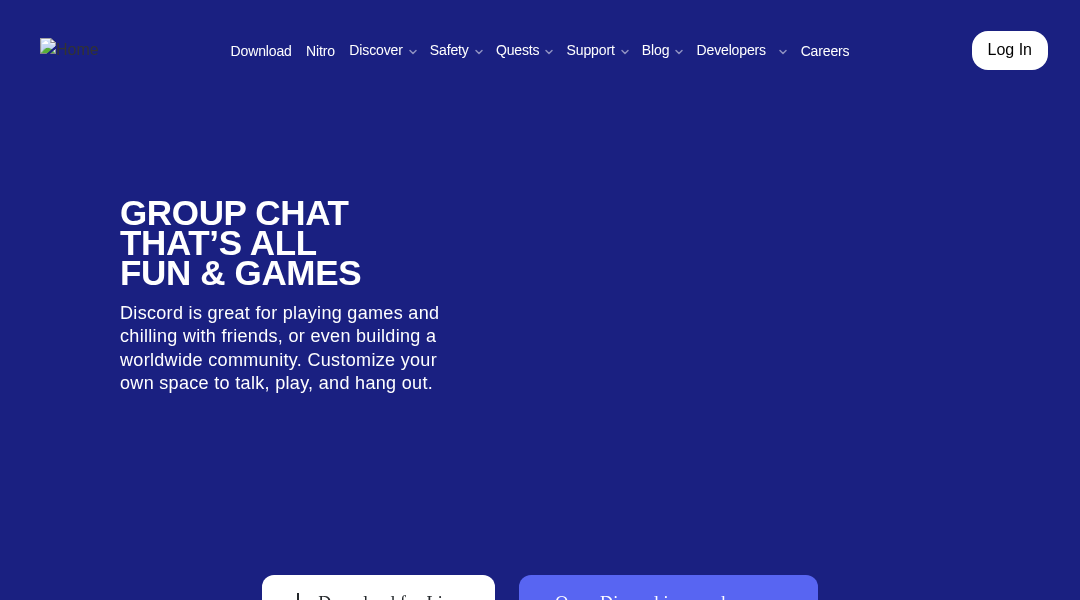
Discord
Frequently Asked Questions
Are Deno Deploy, Discord, and DIY.org actually alternatives to each other?
No. They're grouped together by directory category, not by function. Deno Deploy is serverless application hosting, Discord is a general communication platform, and DIY.org is a subscription learning platform for kids ages 6-16 — there's no meaningful way to choose 'between' them.
Can I use Discord and Deno Deploy together?
Yes, and it's a common pairing in practice — a developer team might coordinate and communicate on Discord while hosting the actual application on Deno Deploy's serverless infrastructure. They're complementary tools in a workflow, not competitors.
Is DIY.org safer for kids than Discord?
They're built for different purposes and audiences. DIY.org is purpose-built for kids ages 6-16 with AI-guided projects, human-reviewed feedback, and a moderated community specifically around that age group. Discord is a general-purpose communication platform used broadly by gamers, creators, and businesses, and isn't designed or moderated specifically for young children.
Does Discord cost money to use?
The core product — creating and joining servers with text, voice, and video chat — is free with no functional paywall. Discord Nitro is an optional personal subscription starting at $2.99/month that adds perks like custom emoji, larger file uploads, and HD video streaming, but it isn't required for full use of Discord.
Is Deno Deploy's free tier enough for a real project?
Deno Deploy offers a generous free tier for hosting JavaScript/TypeScript apps on V8 isolates, but specific usage limits aren't detailed here — developers with production traffic should check Deno Deploy's current plan documentation directly to confirm the free tier covers their expected load.
Read the full Deno Deploy review · Read the full Discord review · Read the full DIY review