inspector.dev vs JFrog Artifactory vs PagerDuty: Which Is Right for You in 2026?
These three don't compete for the same budget line — they solve different DevOps problems that often coexist in the same pipeline. inspector.dev catches and…
Freemium · From Free (paid plans from €15/month)
Best for: PHP shops that want real-time error detection and AI-assisted bug triage baked into a lightweight, affordable APM tool.
Freemium · From Free (Community/OSS edition); Pro from approx. $150/month
Best for: Organizations standardizing on a single, secure binary repository (packages, containers, builds) across their whole software delivery lifecycle.
Freemium · From Free (up to 5 users); paid plans from $21/user/month
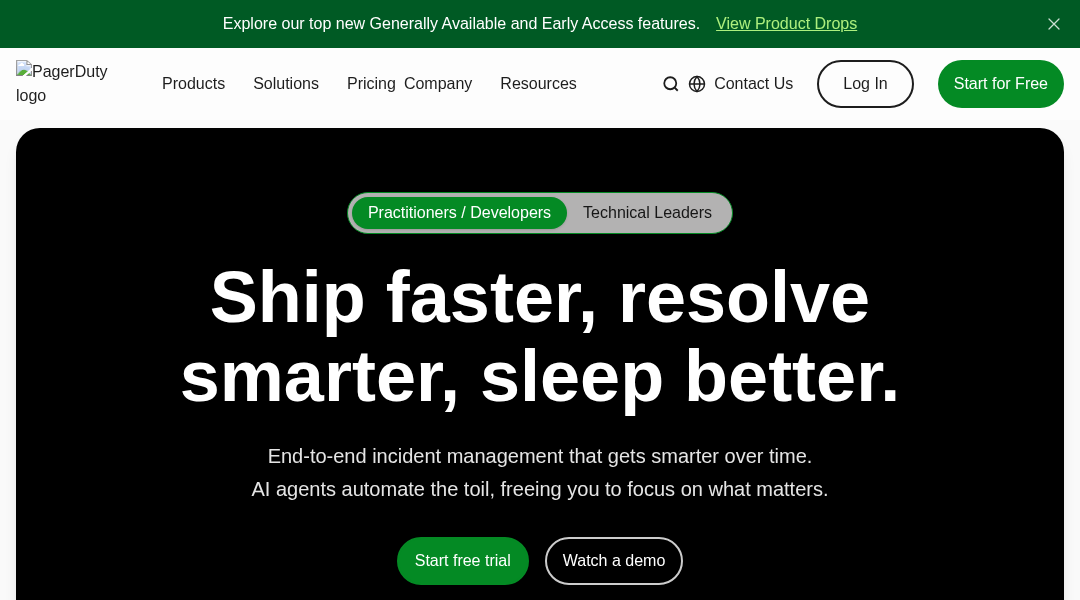
Best for: Ops and engineering teams that need formal on-call rotations, escalation policies, and incident response workflows, including usable free coverage for small teams.
At a Glance
| inspector.dev | JFrog Artifactory | PagerDuty | |
|---|---|---|---|
| Primary category | DevOps | DevOps | DevOps |
| Rating | Not documented | Not documented | Not documented |
| Pricing model | Freemium | Freemium | Freemium |
| Starting price | Free (paid plans from €15/month) | Free (Community/OSS edition); Pro from approx. $150/month | Free (up to 5 users); paid plans from $21/user/month |
| Free plan | Yes | Yes | Yes |
| Free trial | Not documented | Not documented | Not documented |
| Platforms | Not documented | Not documented | Not documented |
| Team collaboration | Not documented | Not documented | Not documented |
| AI features | Yes | Not documented | Yes |
| Public API | Yes | Yes | Not documented |
Standout Differences
Different layers of the same pipeline
inspector.dev watches application code for errors and performance issues, Artifactory manages the artifacts that ship that code, and PagerDuty manages the humans who respond when something breaks. None of the three substitutes for the other two.
inspector.dev, JFrog Artifactory, PagerDuty
Free tier depth varies a lot
PagerDuty's free tier supports up to 5 users with 100 SMS/phone notifications monthly — a genuinely usable on-call setup, not a crippled trial. JFrog offers a free Community/OSS edition of Artifactory before Pro pricing starts around $150/month, while inspector.dev is free to start with the cheapest paid entry point of the three at €15/month.
PagerDuty, JFrog Artifactory, inspector.dev
AI is core to PagerDuty's paid tiers
PagerDuty bakes a monthly "AI Actions" allowance directly into its Professional (1,000) and Business (5,000) plans, scaling to 20,000 on Enterprise, treating AI-assisted response as a standard feature rather than an add-on. inspector.dev applies AI differently — to diagnosing and helping fix bugs inside PHP code, not to orchestrating incident response.
PagerDuty, inspector.dev
Public-company scale vs a focused point tool
JFrog and PagerDuty (NYSE: PD) are both publicly traded companies building for enterprise scale, while inspector.dev is a narrower, PHP-specific point tool by comparison — worth weighing if long-term vendor stability matters to your stack.
JFrog Artifactory, PagerDuty, inspector.dev
Feature-by-Feature
Core Function
| Feature | inspector.dev | JFrog Artifactory | PagerDuty |
|---|---|---|---|
| Application performance monitoring / error tracing | Available | Unavailable | Unavailable |
| Binary/package artifact storage | Unavailable | Available | Unavailable |
| On-call scheduling & alerting | Unavailable | Unavailable | Available |
| AI-assisted workflows | Available | Not documented | Available |
Pricing & Plans
| Feature | inspector.dev | JFrog Artifactory | PagerDuty |
|---|---|---|---|
| Free tier or edition | Available | Available | Available |
| Publicly traded parent company | Not documented | Available | Available |
Pricing Compared
Starting price reflects the lowest paid tier, not the full cost for every team size or usage level.
inspector.dev
JFrog Artifactory
PagerDuty
Pros & Cons
inspector.dev
Pros
- Purpose-built for the PHP ecosystem and popular frameworks
- Free plan available with no cost for smaller projects
- No server-level installation required to get started
- AI Bug Fixer speeds up debugging
- 14-day money-back guarantee on paid plans
Cons
- Narrower focus than general-purpose APM tools like Datadog or New Relic
- Smaller brand recognition compared to major APM vendors
- Transaction limits mean costs rise as usage grows
- Best suited to PHP-only stacks rather than polyglot environments
JFrog Artifactory
Pros
- Broadest package-format support among universal repository managers
- Enterprise-grade security and governance features
- Mature, publicly traded vendor with proven scale
- Strong DevOps and CI/CD tooling integrations
- Free Community/OSS edition available for individuals and open-source projects
Cons
- Per-gigabyte cloud pricing is higher than several competitors
- Enterprise pricing requires custom sales negotiation
- Can be complex to configure and administer at scale
- Self-hosted licensing costs are significant for large deployments
- Full security capabilities require pairing with the separately priced Xray product
PagerDuty
Pros
- Category-leading, enterprise-proven reliability with Fortune 500-scale adoption
- Extensive integration ecosystem (650+ integrations)
- Free tier available for very small teams
- Strong automation and AI-driven incident triage on higher tiers
- Public company with transparent financial reporting and long operating track record
Cons
- Per-user pricing gets expensive quickly for larger response teams
- Advanced automation and AI features are gated behind Business/Enterprise tiers
- Add-ons (AIOps, status pages, runbook automation) can push costs well beyond the base per-user rate
- Enterprise pricing is not publicly disclosed and requires a sales conversation
- Can be more complex to configure than lighter-weight on-call tools for small teams
Use Cases
inspector.dev
- Production error monitoring — Catching and diagnosing errors in live PHP applications in real time.
- Laravel/Symfony performance tracking — Monitoring transaction performance in popular PHP frameworks.
- Agency multi-app monitoring — Tracking errors and performance across multiple client PHP applications.
- Affordable APM for startups — Getting error and performance visibility without a large monitoring budget.
JFrog Artifactory
- Consolidating fragmented package repositories — DevOps teams replace multiple format-specific repositories with one governed Artifactory instance supporting all their package types.
- Securing the software supply chain — Security teams use Artifactory to proxy public registries and block vulnerable artifacts before they reach production builds.
- Scaling CI/CD across global teams — Enterprises with distributed development centers use bi-directional replication to keep artifacts synchronized and builds fast worldwide.
PagerDuty
- Enterprise on-call and incident management — Large engineering organizations use PagerDuty to manage on-call rotations, escalate incidents, and coordinate response across hundreds of services.
- Small team alerting — Small engineering teams use PagerDuty's Free plan for basic on-call scheduling and alerting without upfront cost.
- Automated incident remediation — Organizations use runbook automation and AI-driven triage on Business/Enterprise plans to automatically resolve common incidents without manual intervention.
Screenshots
PagerDuty
Frequently Asked Questions
Do I need to choose between inspector.dev, JFrog Artifactory, and PagerDuty?
No — they cover different jobs in a software delivery pipeline rather than competing for the same use case. inspector.dev monitors a running PHP application for errors, Artifactory stores and secures the build artifacts that ship that application, and PagerDuty handles on-call alerting and incident response once something goes wrong. Many engineering teams use two or all three of these together.
Which of these three has the most usable free plan?
PagerDuty's free tier is the most functional out of the box, supporting up to 5 users with 100 SMS/phone notifications a month — enough to run a real small-team on-call rotation. JFrog Artifactory's free Community/OSS edition covers artifact storage without a described seat limit, while inspector.dev's free plan pairs with the cheapest paid upgrade of the three at €15/month.
Is inspector.dev only for PHP applications?
Yes — per its own description, inspector.dev is built specifically for PHP applications, offering real-time error detection, performance tracing, and AI-assisted bug fixing. Teams on other languages or stacks would need a different APM tool.
Does PagerDuty's AI functionality overlap with inspector.dev's AI bug fixing?
Not directly. PagerDuty's AI Actions automate and scale incident response workflows, with an allowance from 1,000 actions/month on Professional up to 20,000 on Enterprise. inspector.dev applies AI to diagnosing and helping fix bugs inside PHP code. They sit at different points in the incident lifecycle: inspector.dev helps catch and understand the bug, PagerDuty helps the team get notified and coordinate a response.
What does JFrog Artifactory actually store, and why would I need it alongside an APM tool or PagerDuty?
Artifactory is a universal binary/package repository — it stores, secures, and distributes the software artifacts (packages, containers, builds) that move through your SDLC. It doesn't monitor running applications or manage on-call rotations, so teams typically pair it with tools like inspector.dev (to catch runtime errors) and PagerDuty (to respond to incidents) rather than choosing one over the others.
Read the full inspector.dev review · Read the full JFrog Artifactory review · Read the full PagerDuty review