Best App Builders for Small Businesses in 2026
November 16, 2026 · 15 min read
For owners of cafes, salons, gyms, clinics, shops and trades: eleven tools compared on what a small business needs, an app regulars keep, a website people find, and booking, ordering or loyalty behind both. Prices from our listings, November 2026.
What a small business needs from an app builder
Most app builder reviews are written for founders building a startup. A bakery or a physio clinic has a different checklist: people should find you on Google, book or order without calling, pay up front, and come back. The software behind that, a calendar, an order list, a loyalty card, matters more than the design.
In practice that is three pieces: a website people find through search, an app regulars keep on their phone, and the tools behind both. Some builders cover all three, most cover one or two, and a few are specialists for a single industry.
We compared eleven tools listed on Gappsy against those needs, with prices from our listings as of November 2026. Disclosure: Gappsy is our own product. It is covered first because it was built for this exact use, and its limits are listed next to everyone else's.
Six questions to ask before you choose
Does it take bookings or orders, or only show a contact form? A form means you still confirm everything by phone. Look for real-time booking or ordering with payment.
Who takes a cut of each payment? Card processing always costs something. Some platforms add their own fee on top: Gappsy on Free and Pro, Squarespace on Basic, Owner.com on its Flexible plan, and Fresha on new clients from its marketplace.
Will customers keep it on their phone? A website is found once. An app on the home screen, with push messages and a loyalty card, is seen every week.
App Store or home screen? A store listing costs $99 a year for Apple and $25 once for Google, plus review time. A home-screen app opens from a link or QR code with no review.
Can you change a price or your opening hours in a minute? You will do it often. Try it during the trial.
What does month twelve cost? Compare yearly totals and fees at your expected sales, not the headline price.
1. Gappsy: best for an app, a website and booking, ordering or loyalty in one
Disclosure: Gappsy is our own product. Weigh this pick with that in mind; its limits are listed below.
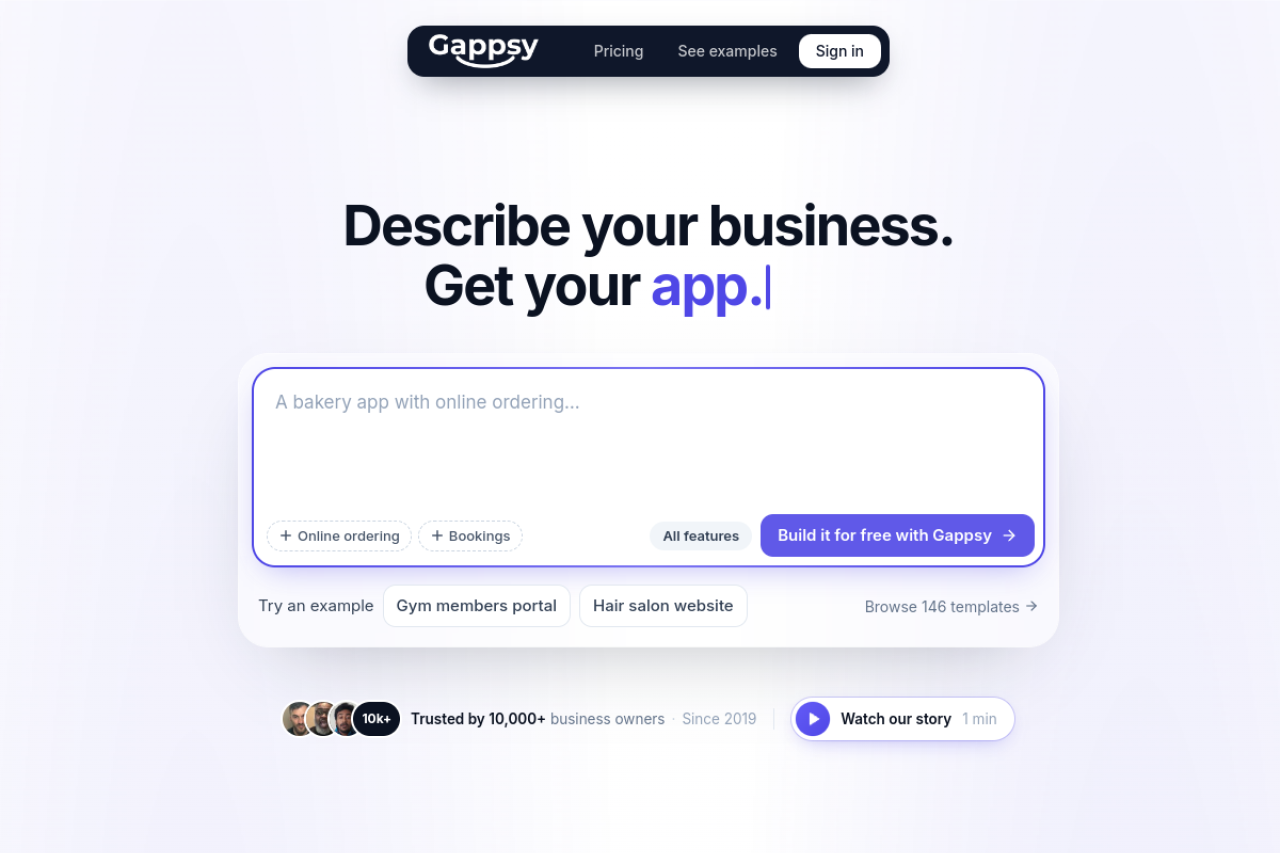
Gappsy asks what your business is and builds the app, the website and the tools in one go. A cafe gets a menu with ordering and a stamp card, a salon gets online booking with reminders, a gym gets class booking and memberships that renew on their own. Customers pay into your own Stripe account. They add the app to their home screen from a link or QR code, get push messages on the lock screen, and keep a loyalty card in Apple Wallet or Google Wallet.
You don't design pages. You change things by typing ("add a lunch menu", "make it feel more premium") or by tapping a text, photo or price to edit it, which is unlimited on every plan. The trade-off is design freedom: Wix and Squarespace let you place every element, Gappsy does not.
There are ready-made starting points for about 195 business types, including cafes, bakeries, barbershops, nail studios, personal trainers, physiotherapists, florists and electricians. See them all on the app builder by business type page.
Plans as of November 2026: Free ($0) runs one app on yourname.gappsy.co with every feature, including payments, for up to 300 visitors and 10 typed AI changes a month, with a 5% fee and a Gappsy label. Pro ($19 a month billed yearly, $29 monthly) adds your own domain, removes the label, lowers the fee to 1%, raises the limits to 3,000 visitors and 50 AI changes, and lets you publish to the App Store and Google Play with your own developer accounts. Business ($55 a month yearly, $79 monthly) covers 5 apps, 150,000 visitors and no Gappsy fee, which suits several locations. New apps start with a 14-day Pro trial without a card.
See Gappsy vs Wix and Appy Pie vs Gappsy, or start on the Free plan.
Pros
• App, website and booking, ordering or membership tools from one description
• Wallet loyalty card and push messages on every plan
• Payments go to your own Stripe account, even on Free
• Several locations or brands on one Business plan (5 apps)
Cons
• Less design control than Wix or Squarespace
• Built from fixed feature blocks, so unusual workflows may not fit
• Free plan limits are low for a busy shop (300 visitors a month)
• App Store publishing needs your own developer accounts and a Mac, or the $600 service
Best for: cafes, restaurants, salons, gyms, studios, clinics and service businesses that want customers to book, order and return, with one tool instead of three.

An app, a website and booking, ordering or loyalty tools for your business, from one description.
2. Wix: best for a design-led website with bookings and an online store
Wix is a website builder first. AI generates a starting site from a short description, then you edit freely in a drag-and-drop editor with a large template library. Wix Bookings manages appointments, staff calendars and service payments, Wix Stores handles products, cart, checkout and inventory, and the App Market adds hundreds of extras. Developers can add custom logic with Velo.
Wix has a free tier, but it is limited to a Wix-branded domain with Wix ads and no ecommerce, so a real business site needs a paid plan. Our listing shows Light at $17 a month (custom domain, no ads, still no ecommerce), Core at $29 (ecommerce and payments), Business at $39 (advanced ecommerce, automations, priority support) and Business Elite at $159, all billed annually. For a business that takes payments, Core is the realistic starting point.
See Gappsy vs Wix and Squarespace vs Wix.
Pros
• Detailed design control and many templates
• Bookings and a full online store on one platform
• Large app marketplace for extras
Cons
• Taking payments needs Core ($29 a month billed annually) or higher
• Costs grow with premium apps and higher store tiers
• Sites cannot be moved to another host
Best for: shops and service businesses whose website is the main storefront and who want to design it themselves.
3. Squarespace: best for a polished website with selling and member areas
Squarespace is known for designer templates. Beyond the site, it sells physical products, digital downloads, memberships and courses, gates content behind free or paid member areas, and sends email campaigns using the same brand assets. AI tools help with the first layout and copy.
Billed annually, our listing shows Basic at $16 a month with a 2% transaction fee, Core at $23 with that fee waived, Plus at $39 with lower card rates (2.7% + $0.30) and Advanced at $99 (2.5% + $0.30). There is a 14-day free trial, but it cannot publish, so going live needs Basic at $16 a month billed annually.
See Squarespace vs Wix.
Pros
• Strong templates with little effort
• Email marketing and selling built in
• Member areas for courses or content
Cons
• No free plan that can go live
• 2% transaction fee on Basic
• Changing templates after launch can mean rebuilding
Best for: studios, boutiques, photographers and coaches who want a polished site and sell products, memberships or courses.
4. Durable: best for service businesses that want to be found and booked
Durable builds a website from a business description and wraps it in tools for winning customers: a built-in CRM, online booking synced to your calendar, review requests, Google Business Profile and directory listings, and SEO features aimed at Google and AI answers. Paid plans add AI agents that reply to leads and reviews, write blog posts and research competitors.
Per our listing, Durable has a free tier, but it is limited to 300 AI credits in total, a CRM for 10 customers and a durable.site subdomain, so a real business needs Launch at $25 a month (unlimited booking, unlimited CRM, a custom domain, 1,000 AI credits a month) or Grow at $49 a month (unlimited team members, automatic translation, 5,000 credits). Yearly billing saves about 15%.
Pros
• Website, CRM, booking and review requests in one subscription
• The free tier goes live on a subdomain, though with 300 AI credits in total, so growing businesses need Launch at $25 a month
• Local search tools such as Google Business Profile
Cons
• Our listing documents a website, not a phone app
• Not designed for ecommerce
• AI features use credits, so heavy use may need Grow
Best for: plumbers, cleaners, consultants and other service businesses whose main goal is more leads and bookings from search.
5. Appy Pie: best for a native app in the app stores
Appy Pie turns a prompt into an Android and iOS app and walks you through store submission. Its business modules cover loyalty cards, coupons, events, room reservation, dine-in and food court ordering, and payments are pre-wired for Stripe, PayPal, Apple Pay, Google Pay and regional gateways.
Pricing is per app per month: Basic $16 and Gold $36 for Android, Platinum $60 for Android and iOS. Each plan caps push notifications and downloads at 500, 1,000 or 2,000 a month. Add Apple's $99 a year and Google's one-time $25 for the store accounts.
See Appy Pie vs Gappsy.
Pros
• Real store apps with submission help
• Restaurant and loyalty modules
• Many payment gateways
Cons
• An iPhone app needs the $60 Platinum plan
• Monthly caps on pushes and downloads
• A website is not documented; removing branding is an add-on
Best for: restaurants and retailers who want their own listing in the App Store and Google Play.
6. Glide: best for a staff app on your spreadsheets
Not every small business app is for customers. Glide turns a Google Sheet, Airtable base or Excel file into an app for your team: stock counts, job sheets, shift checklists, a simple customer list. Data syncs both ways, so the spreadsheet stays the source of truth.
Our listing shows a free tier for building and testing only, since it cannot publish, so a live app needs a paid plan: Basic at $25 a month, Plus at $50 or Pro at $125, priced by team members, credits and published apps.
See Gappsy vs Glide.
Pros
• Uses the spreadsheets you already have
• Workflows and AI data extraction
• Quick to build for internal use
Cons
• The free tier cannot publish, so going live needs Basic at $25 a month
• Customer checkout and bookings are not documented in our listing
• Price rises with team size and credits
Best for: owners and managers who run operations from spreadsheets and want them on staff phones.
7. Adalo: best for a custom app you design screen by screen
Adalo is a drag-and-drop builder for native iOS, Android and web apps, with a hosted database and an AI assistant. It suits a business with an idea templates don't cover, such as an unusual booking flow or a members' app with its own data, and the patience to design it.
Adalo has a free tier, but it is limited to test apps, so publishing to the stores and the web needs Builder at $65 a month or Business at $200 a month, with 20% off yearly.
See Adalo vs Gappsy.
Pros
• Full control over screens and data
• Native store apps
• Plan prices rather than usage meters
Cons
• Higher entry price ($65 a month) than Glide or Softr
• Takes time to design
• Record limits on lower tiers
Best for: businesses with a specific app idea and the time to build it.
8. Softr: best for client portals
Softr builds portals on Airtable, Google Sheets, HubSpot or its own databases. For an accountant, agency, consultant or property manager, that means clients log in to see their documents, invoices, project status or bookings, with permissions per user and Stripe payments.
Softr's free tier is capped at 5 app users and 5,000 records, so real projects need a paid plan. Billed yearly: Basic $19 a month, Pro $99, Business $329 (billed monthly: $25, $119, $395). Non-profits get 50% off.
See Gappsy vs Softr.
Pros
• Client logins and permissions built in
• Builds on data you already keep
• Half price for non-profits
Cons
• Price rises with users
• Loyalty cards and push messages are not documented
• Complex logic needs workarounds
Best for: professional services that want a private client area.
9. Owner.com: best for restaurants with steady online orders
Owner.com is built only for restaurants. It provides a website, commission-free online ordering, a branded mobile app, loyalty and rewards, AI marketing, catering order management and chargeback protection.
Our listing shows two plans: Flexible at $249 a month plus a 5% fee per order, and Flat Rate at $499 a month with no per-order fee, described as better value above about $5,000 a month in online sales. Guests also pay a separate order support fee.
Pros
• Ordering, an app and loyalty from one restaurant vendor
• Catering orders and chargeback protection
• Flat-rate option with no per-order fee
Cons
• $249 to $499 a month is a lot for a small cafe
• 5% per order on Flexible
• Multi-location pricing needs a sales call
Best for: restaurants with steady online order volume that want a specialist to run ordering and marketing.
10. Fresha: best for salons and spas that want marketplace bookings
Fresha is booking and payment software for salons, barbers, spas and similar businesses. It covers 24/7 online booking, staff calendars, digital payments and POS, SMS reminders, consultation forms and reviews, and lists your business on Fresha's consumer marketplace where new clients can find you.
Per our listing: Independent at $19.95 a month for a single operator, Team at $14.95 per team member a month, and Enterprise on request. Card fees apply, and new clients who arrive through the marketplace carry a one-time 20% commission.
Pros
• Built for beauty and wellness bookings
• New clients from the marketplace
• Reminders and consultation forms
Cons
• 20% commission on new clients from the marketplace
• Card fees on top of the subscription
• A single operator pays more per month than one Team seat
Best for: salons, barbers and spas whose main need is a full calendar.
11. Square: best for an online store tied to in-person sales
Square is payments and point of sale first. Its no-monthly-fee plan includes an online store alongside in-person card payments, inventory, invoicing, appointments and reporting, though it is limited: online sales cost a higher card rate and advanced features need Plus. A shop or cafe with a till can sell online without another subscription.
There is no monthly fee on the basic plan, but you pay processing of 2.6% + 15c in person and 3.3% + 30c online. Plus is $49 a month per location (2.9% + 30c online) and Premium is $149 a month per location.
Pros
• Online store with no monthly fee, at a higher online card rate (Plus is $49 a month per location)
• One system for the till and the website
• Appointments and invoicing included
Cons
• Higher online card rate without a paid plan
• Advanced features need Plus or Premium per location
• No installable customer app documented
Best for: shops, cafes and market sellers already taking card payments in person.
Which builder fits your kind of business
Cafes, bakeries and takeaways. You need a menu, ordering for collection, and a reason for people to come back. Gappsy covers ordering, gift cards and a stamp card in the customer's wallet; see the ready-made apps for cafes, bakeries, pizzerias, food trucks and bubble tea shops. Square adds a till if you need one, and Owner.com fits restaurants with high online order volume.
Restaurants and bars. Table bookings, ordering and events. Gappsy apps for restaurants, sushi bars, cocktail bars and breweries; Owner.com if online ordering is a large share of revenue; Wix if the website's design matters most.
Salons, barbers and beauty. Online booking with reminders, gift cards and a loyalty card. Gappsy apps for hair salons, barbershops, nail studios, lash and brow studios and med spas. Fresha if you want new clients from a marketplace and accept the commission on them.
Gyms, studios and coaches. Class booking and memberships that renew automatically. Gappsy apps for gyms, yoga studios, pilates studios, CrossFit boxes, martial arts schools and personal trainers. Squarespace member areas suit coaches selling courses.
Clinics and health practices. Appointment booking, intake forms and a clear services page. Gappsy apps for dentists, medical clinics, physiotherapists, chiropractors, therapists and vets. Check the health-data rules in your country before collecting medical details through any builder.
Shops and boutiques. A product catalog, checkout and repeat customers. Gappsy apps for online stores, florists, fashion boutiques, bookshops and pet shops; Wix Stores or Squarespace for larger catalogs with inventory; Square if you also sell in person.
Trades and home services. Quote requests, bookings, reviews and being found locally. Gappsy apps for plumbers, electricians, cleaning services, landscapers, roofers and heating and air conditioning; Durable if search visibility and a CRM for leads come first.
Professional services. A credible site, booking and a place for clients to log in. Gappsy apps for accountants, law firms, consultants and real estate agents; Softr for a client portal on data you already keep.
Your business isn't listed? Browse every business type.
Small business app builders compared
"Not documented" means our listing for that tool does not mention it, not that it is impossible.
| Tool | Best for | Starting price | Phone app | Website | Booking, ordering, loyalty |
|---|---|---|---|---|---|
| Gappsy | All-in-one for local businesses | Free; Pro $19/mo yearly ($29 monthly) | Installable app; store packages on Pro | Yes, same content as the app | All three built in |
| Wix | Design-led websites | Limited free tier (Wix ads, no ecommerce); Core $29/mo for payments (annual) | Not documented | Yes | Bookings and store; loyalty not documented |
| Squarespace | Polished sites, selling, members | Basic $16/mo (annual) | Not documented | Yes | Selling and member areas |
| Durable | Leads and bookings for services | Limited free tier (300 AI credits total); Launch $25/mo | Not documented | Yes | Booking and CRM |
| Appy Pie | Native store apps | $16/app/mo (Android) | Native Android; iOS from $60/mo | Not documented | Reservations, dine-in, loyalty |
| Glide | Staff apps on spreadsheets | Free tier can't publish; Basic $25/mo | Web and mobile app | Not documented | Not documented |
| Adalo | Custom native apps | Free tier can't publish; Builder $65/mo | Native iOS and Android | Web app | You build it |
| Softr | Client portals | Limited free tier (5 app users); Basic $19/mo (yearly) | Not documented | Portal | Stripe payments |
| Owner.com | Restaurants | $249/mo + 5% per order | Branded app | Yes | Ordering and loyalty |
| Fresha | Salons and spas | $19.95/mo (Independent) | Not documented | Marketplace listing | Booking |
| Square | Shops with in-person sales | No monthly fee, higher online card rate (3.3% + 30c); Plus $49/mo per location | Not documented | Online store with no monthly fee, at the higher card rate | Store and appointments |
Prices from our published listings as of November 2026. Card processing fees apply on top with every tool.
What the first year costs at small-business scale
Headline prices hide the real bill. Here is one year on the cheapest plan of each tool that takes payments online, using our listing prices and before card processing:
• Gappsy Pro, billed yearly: $228, plus a 1% fee on payments (Free costs $0, with a 5% fee)
• Squarespace Basic: $192, plus a 2% transaction fee (Core, at $276, waives it)
• Fresha Independent: $239.40, plus card fees and 20% on new marketplace clients
• Durable Launch: $300
• Wix Core: $348
• Adalo Builder, billed yearly: $624
• Appy Pie Platinum, Android and iOS: $720 per app, plus $99 a year to Apple and $25 once to Google
• Owner.com Flexible: $2,988, plus 5% per order
Once sales grow, platform fees often matter more than the subscription. Run your expected monthly sales through each fee before deciding: at $5,000 a month in sales, a 1% fee is $50 a month and a 5% fee is $250.
How to decide in an afternoon
Write down the one job the app must do. Booking, ordering, memberships or a loyalty card. Shortlist only tools that do that job on the plan you would buy.
Build your business twice. Most tools here have a free plan or a trial, but they are limited (branding, small caps, no payments or no publishing), so treat them as a test, not a way to run the business. Describe your business to two of them and compare what you have after 15 minutes.
Test it as a customer. Book, order and pay on your own phone, and count the taps.
Hand it to whoever will update it. If a staff member will change the menu or the prices, let them try before you commit.
Weighing these against developer tools such as Lovable or Bubble? Our guide to the best AI app builders sorts eleven builders by who they are for.
Frequently Asked Questions
What is the best app builder for a small business?
For a local business that wants an app, a website and booking, ordering or loyalty in one tool, Gappsy (our own product) covers all three from one description. Wix and Squarespace are stronger when the website's design is the priority, Durable when leads and search visibility matter most, and Appy Pie when you specifically want a native store app.
Does a small business need an app or just a website?
A website is how new customers find you; an app is how regulars come back. If repeat visits drive your revenue, as in cafes, salons and gyms, an app with push messages and a loyalty card is worth having. Gappsy builds both from the same content, so you don't have to choose.
How much does it cost to build an app for a small business?
With an app builder, from $0 to about $60 a month for most small businesses. Gappsy's Free plan goes live at $0; Durable's free tier also goes live but is limited to 300 AI credits in total, so most businesses need Launch at $25. Gappsy Pro is $19 a month billed yearly, and Appy Pie with iOS is $60 per app per month. Restaurant specialists such as Owner.com start at $249 a month plus 5% per order.
Can I take bookings and payments in a small business app?
Yes, with most tools here. Gappsy, Wix (Core and up), Durable (paid plans), Fresha and Appy Pie all handle bookings or reservations with payments. Check any platform fee on top of card processing, for example 5% on Gappsy Free and 1% on Pro.
Do I need to be in the App Store?
Not necessarily. Customers can add a web app to their iPhone or Android home screen from a link or QR code, with your icon and push notifications, and no store review. Store listings help if people search the stores for businesses like yours, and cost $99 a year for Apple and $25 once for Google.
Which app builder is best for restaurants?
Owner.com is a restaurant specialist with ordering, a branded app and loyalty from $249 a month plus 5% per order. Gappsy covers ordering, table booking, gift cards and a Wallet loyalty card from $0. Square suits restaurants that also need a till.
Which app builder is best for salons?
Gappsy for your own booking app and website with a Wallet loyalty card, Fresha if you want new clients from its marketplace and accept a one-time 20% commission on them, and Wix Bookings if you already run a Wix site.
Can I move my app to another builder later?
Usually only by rebuilding. Most of these tools run your app on their own platform, and Wix and Gappsy both state there is no export to another host. Keep your customer list and content somewhere you can export, and choose a tool you can grow into.